Week 7 Neuroscience + Art
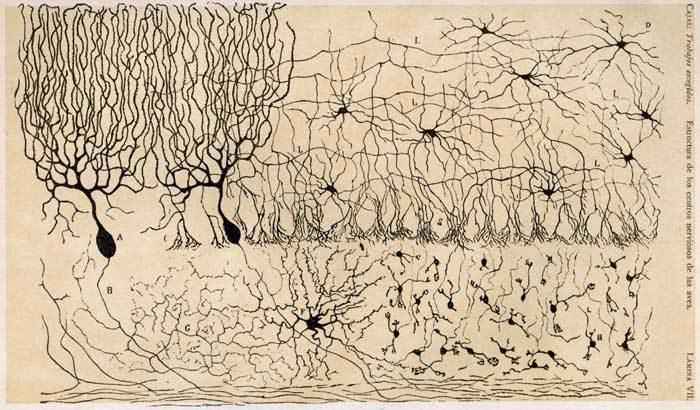 |
| Image Credit: (Cajal, 1905) |
The world of neuroscience and its interplay with art ranges widely with artistic approaches from two ends of the spectrum. From one end, we see art produced driven largely by scientific methods of inquiry as represented by the Brainbow brain photography produced by a Harvard Neuro-research team led by Jeff Lichtman who themselves were inspired by the sketches of Santiago Ramón y Cajal. Lichtman and his team were able to produce photographs delineating individual neurons in the brain by using fluorescent dyes of varied colors injected which produced bright and colorful images that are a testament to the artistry of science. It is noteworthy that Cajal’s own images, which also catalog the structures of neurons, bear a striking resemblance the brainbow, albeit without the vibrant colors.
 |
| Image Credit: (Lichtman, 2007) |
In contrast, other artists have purposefully ingested hallucinogenic drugs to change their brain chemistry to see its effect on their own perceptions of self and in turn, its effects on the art they could produce. An anonymous internet artist known by the handle “whatafinethrowaway”, inspired by the LSD research of psychiatrist, Oscar Janiger, created 9 self portraits over the course of a few hours after taking LSD. One cannot help but see similarities in the artwork produced by both Lichtman and whatafinethrowaway as both are wildly colorful and produce a sense of playfulness.
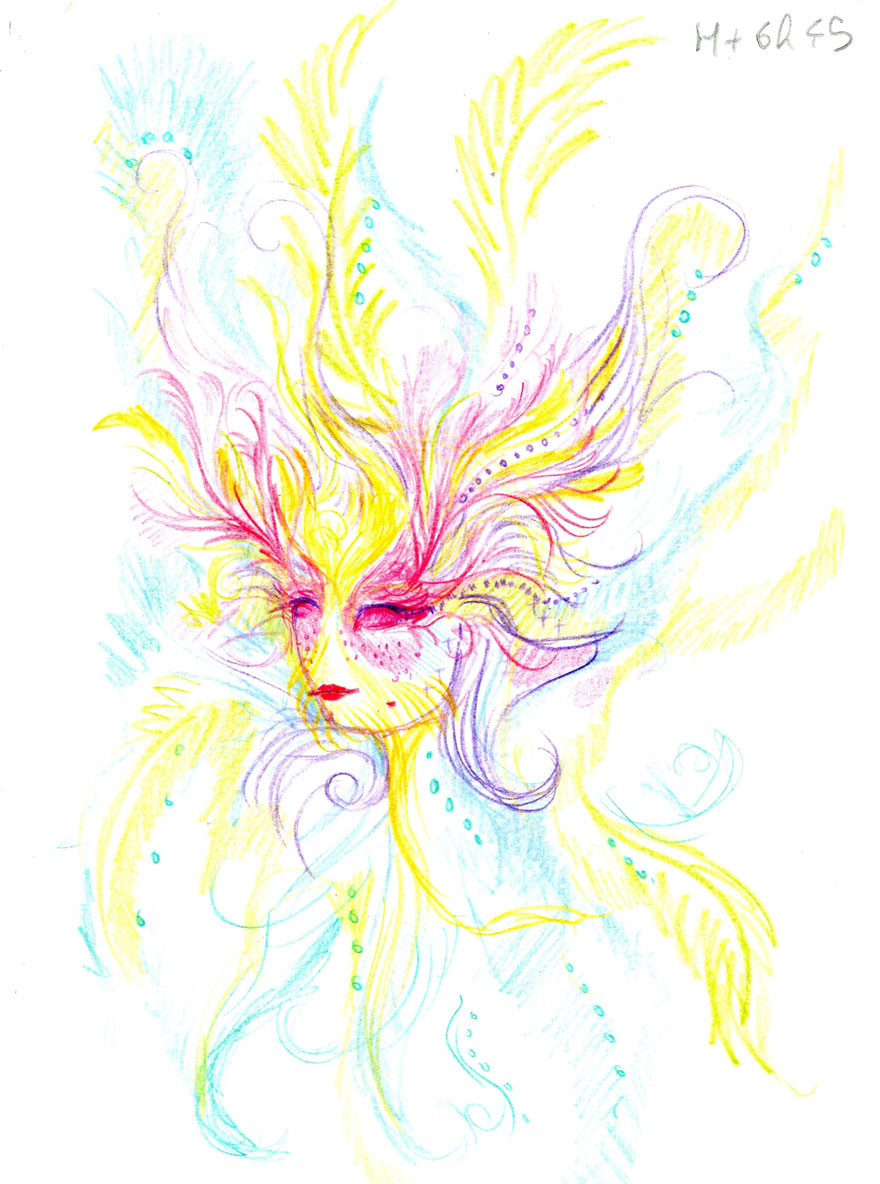 | ||
| Image Credit: (whatafinethrowaway, 2016) |
Image Credits
Cajal, S. (1905). "Estructura de los centros nerviosos de las aves,". Butterflies of the Soul. Harvard. https://hms.harvard.edu/news/butterflies-soul.
Lichtman, J. (2007). Brainbow. Harvard Brain Tour. https://braintour.harvard.edu/archives/portfolio-items/brainbow.
whatafinethrowaway. (2016). Self-portait: 6H 45M after Lsd ingestion. Bored Panda. https://www.boredpanda.com/lsd-portrait-drawings-girl/?utm_source=google&utm_medium=organic&utm_campaign=organic.
Resources
Center for Brain Science (Ed.). (2020). Brainbow. Brainbow | Center for Brain Science. http://cbs.fas.harvard.edu/science/connectome-project/brainbow.
Cohut, M. (2021). Phrenology: What is it, and how did it contribute to neuroscience? Medical News Today. https://www.medicalnewstoday.com/articles/phrenology-the-pseudoscience-of-skull-shapes.
Dainius. (2016, January). Artist Used LSD And Drew Herself For 9 Hours To Show How It Affects Brain. Bored Panda. https://www.boredpanda.com/lsd-portrait-drawings-girl/?utm_source=google&utm_medium=organic&utm_campaign=organic.
Jiang, K. (2018, March 30). Butterflies of the Soul. Butterflies of the Soul | Harvard Medical School. https://hms.harvard.edu/news/butterflies-soul.
UC Online. (2012). Neuroscience-pt1.mov. YouTube. https://www.youtube.com/watch?v=TzXjNbKDkYI&t=130s.
Wolchover, N. (2011, March 30). Slideshow: Scientists Analyze Drawings by an Acid-Tripping Artist. LiveScience. https://www.livescience.com/33166-slideshow-scientists-analyze-drawings-acid-trip-artist.html.


Comments
Post a Comment