Week 9: Space + Art
I remember watching the “Powers of 10” film as well as Carl Sagan’s pale blue dot as a kid in elementary school. I remember feeling so small and insignificant after viewing each video. Looking back on it, my understanding then was limited compared to my understanding today, but I still get the same feeling of insignificance, although on a grander scale, after watching these videos as an adult. For me, space as a subject must be art in itself, as its very presence is enough to evoke strong emotions when I ponder the vastness of the cosmos.
 |
| Image Credit: (NASA/JPL-Caltech, 1990) |
Space photography is one of my favorite forms of art. The blend of science with artistic principle creates some truly fantastic images. A modern telescope uses physics and mathematics in order to track heavenly bodies in the sky and allows a person to capture the image on a camera. Some dedicated artists will take thousands of images and blend them into a single ultra-high resolution image, such as the work of Andrew McCarthy pictured below.
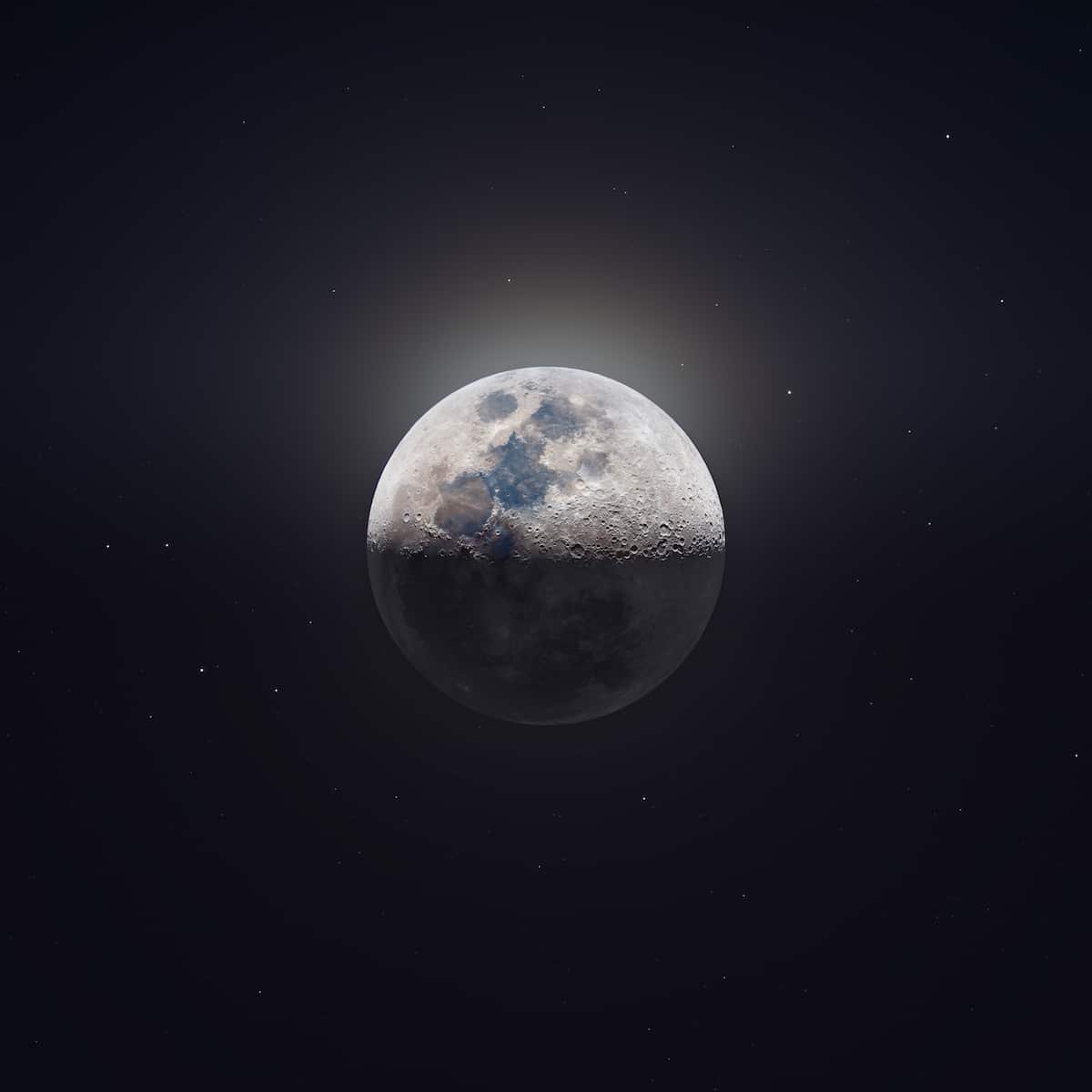 |
| Image Credit: (McCarthy, 2020) * image is not in original resolution* |
When I listen to Carl Sagan speak about Earth as a pale blue dot in space, I cannot help but think he is a true representation of the third culture, the amalgamation of science and art in a single person. Sagan’s words purify language in to add clarity to a subject but also to highlight the inherent beauty of the universe. Within four minutes, Sagan blurs the lines between science, history, politics, sociology, and art, to evoke wonder and a thirst for discovery in his audience.
carlsagandotcom. (2015). Carl Sagan's Pale Blue Dot Official. YouTube. https://www.youtube.com/watch?v=GO5FwsblpT8.
McCarthy, A. (2020). High Resolution Image of the Moon. Instagram. https://www.instagram.com/p/B9vCTGWpwgg/?utm_source=ig_embed&ig_rid=b0b1bd48-be6d-4b3b-9635-f1992bf9d088.
NASA/JPL-Caltech. (1990). Voyager 1's Pale Blue Dot . https://solarsystem.nasa.gov/resources/536/voyager-1s-pale-blue-dot/.
Resources
Achenbach, J. (2014, March 1). Why Carl Sagan is Truly Irreplaceable. Smithsonian.com. https://www.smithsonianmag.com/science-nature/why-carl-sagan-truly-irreplaceable-180949818/.
Carter, J. (2021, April 15). Astrophotography: a beginner's guide. BBC Sky at Night Magazine. https://www.skyatnightmagazine.com/astrophotography/a-beginners-guide-to-astrophotography/.
NASA/JPL. (n.d.). Voyager. NASA. https://voyager.jpl.nasa.gov/.
Stewart, J. (2020, September 3). Ultra High-Definition 85-Megapixel Photo of the Moon Captures Every Tiny Crater. My Modern Met. https://mymodernmet.com/85-megapixel-moon-andrew-mccarthy/.
UC Online. (2012). Space pt4. YouTube. https://www.youtube.com/watch?v=J5ClKO6AJPo&t=203s.

Comments
Post a Comment